THE NAME’S PATRON: SIEGMUND SELIGMANN
Siegmund Seligmann, the former owner and namesake of Villa Seligmann, was born in Verden an der Aller on August 19, 1853. After an apprenticeship in a manufactured goods business, he joined Continental-Caoutchouc- & Gutta-Percha-Compagnie AG in Hanover, which had been founded five years earlier, as an authorized signatory in 1876. In 1879, at the age of just 26, he became commercial director and a member of the company’s management board
The Seligmann era marked a significant rise for Continental in the German rubber industry. Under his leadership, the company developed into a world-class enterprise. As commercial director, Seligmann made a significant contribution to the growth and diversification of the company.
Siegmund Seligmann received numerous honors and awards for his services to Continental. Among other things, he was an honorary member of the Chamber of Industry and Commerce and was appointed Privy Councillor of Commerce, a title awarded to successful business personalities. He was not only an important industrialist, but also a generous patron of the arts who supported foundations in Hanover and Verden. In 1923, on the occasion of his 70th birthday, he was made an honorary citizen of the city of Hanover. Siegmund Seligmann died on October 12, 1925 at the age of 72.
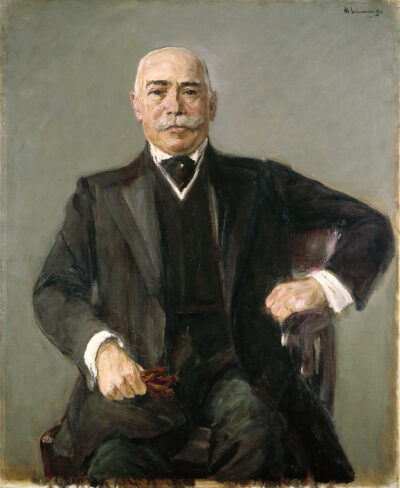
In 1910, Siegmund Seligmann had himself portrayed by the painter Max Liebermann. Today, the portrait is on permanent loan from the descendants of Siegmund Seligmann and can be seen in the Villa Seligmann.
THE SELIGMANN FAMILY
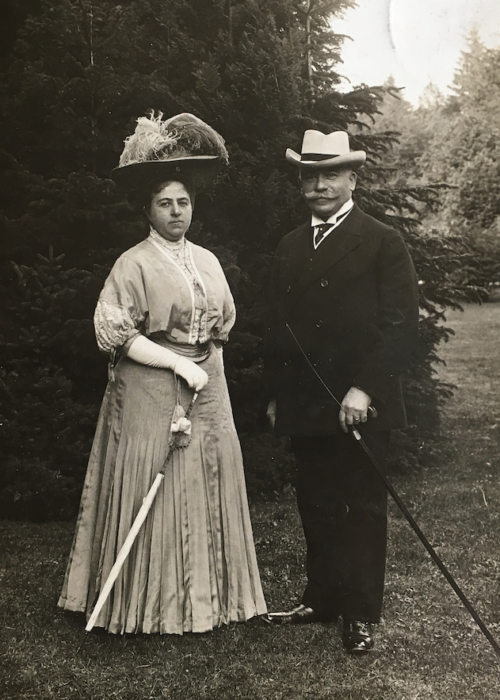
In 1883, Siegmund Seligmann married Johanna Coppel (1861–1949), the daughter of a successful industrialist from Solingen. The couple had one son, Edgar (1884–1939). The couple moved into Villa Seligmann on Hohenzollernstraße in 1906.
Shortly after her husband’s death, Johanna Seligmann emigrated to Switzerland. She continued to visit Hannover regularly until the winter of 1938–39. She died in Lucerne in 1949.
Even before World War I, Edgar Seligmann married his first wife, Frida Kaehne. They had two children, Klaus (1915–2001) and Inge (1918–1981). The couple divorced as early as 1922. After his father’s death, Edgar Seligmann succeeded him on the Executive Board of Continental. He later moved to the Supervisory Board. In 1931, he married his second wife, Dorothea (1900–1988), usually called Thea. The couple had one daughter together, Ellen (1931–2018).
In 1933, following the Nazis’ rise to power, Edgar was forced to resign from his position on the supervisory board. On November 10, 1938, he was arrested and deported, along with 300 other men from Hanover, to the Buchenwald concentration camp. He was released after a few weeks on the condition that he leave the country immediately, but died in Switzerland a few months after his release as a result of the abuse he suffered during his imprisonment.
Edgar Seligmann’s wife and children survived the Shoah. The family’s descendants now live in South America, Switzerland, and Munich.
THE INITIATOR: PROF. ANDOR IZSÁK
100 years after the completion of Villa Seligmann and Siegmund Seligmann’s moving into the house, the Siegmund Seligmann Foundation was established in 2006, initiated by Professor Andor Izsák. Enabled by a great amount of civic commitment, the foundation for Villa Seligmann, the House of Jewish Music, was laid in order to create a place of encounter and dialogue.
Professor Izsák was born in Budapest in 1944 and studied at the Franz Liszt Academy of Music. Already in his student days, he was organist at the Budapest Dohány Synagogue, the largest synagogue in Europe. After many years of teaching at the Béla Bartók Conservatory and the legendary Fodor Music School, as well as choral and opera conductor, Andor Izsák moved to Germany.
His intensive involvement with Jewish music (compositional activities, teaching, research and performances with renowned representatives of synagogal music from all over the world) resulted in the founding of the European Center for Jewish Music in 1988. It became an institute of the Hanover University of Music, Drama and Media under his direction in 1992. In 2003 Andor Izsák was appointed to the professorship of Synagogal Music.
Today, Professor Izsák holds the position of Honorary President of the Siegmund Seligmann Foundation and the Siegmund Seligmann Gesellschaft e.V. as well as of the Friends of Villa Seligmann e.V. Dr. Arno Beyer, former deputy director of the NDR, published a biography about Professor Izsák’s life, titled “Andor der Spielmann – Ein jüdisches Musikerleben”.